







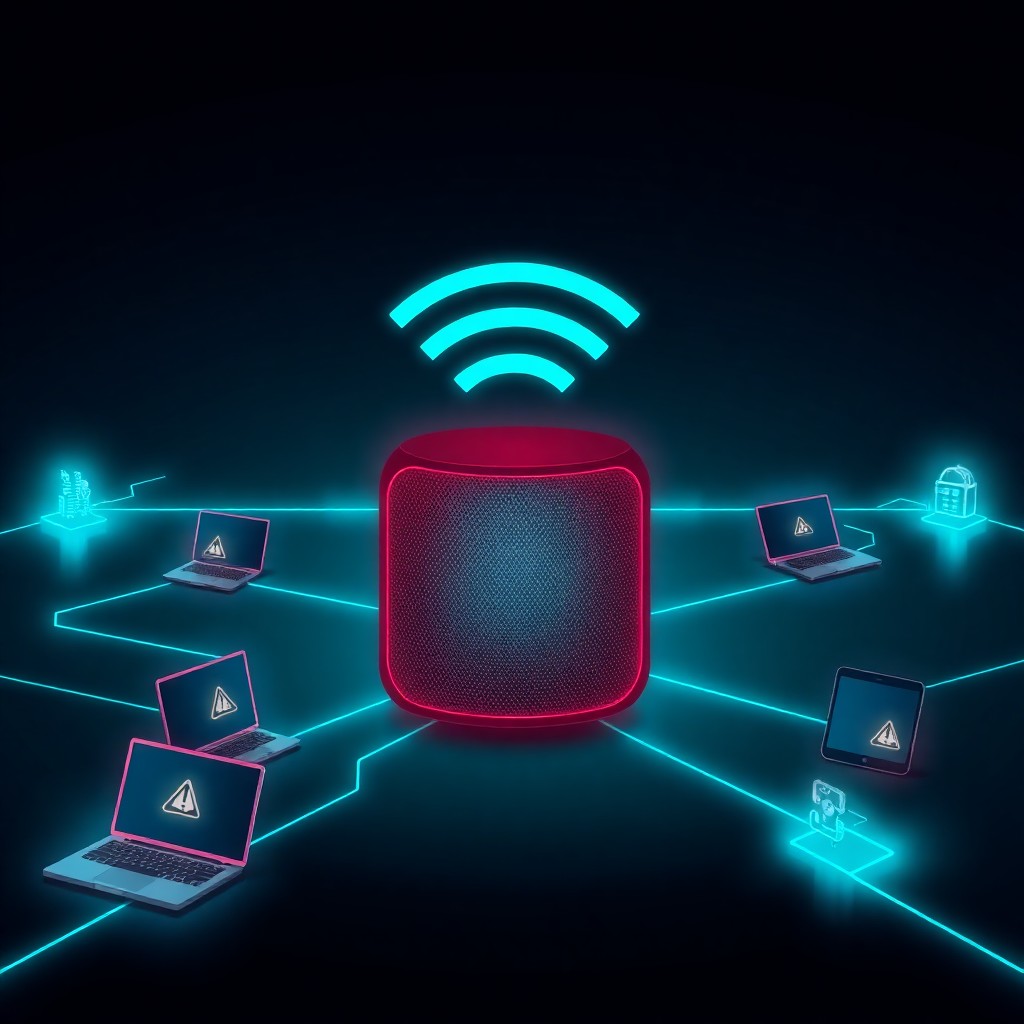
Critical Wireless Exploit in Popular Smart Speaker Enables Silent Network Takeover
A critical zero-day vulnerability in a widely deployed smart speaker allows attackers to gain remote code execution through wireless exploitation without user interaction. The flaw affects the device’s Wi-Fi chipset implementation, enabling attackers within wireless range to compromise the speaker and pivot to other connected devices on the network. Millions of devices remain vulnerable as patches are being developed, creating an urgent security crisis for home and enterprise networks.
Introduction
Security researchers have uncovered a severe wireless exploitation vulnerability in one of the market’s most popular smart speaker models. The flaw, which requires no user interaction and can be exploited from up to 100 feet away, allows attackers to completely compromise the device and establish persistent access to the victim’s network.
What makes this vulnerability particularly dangerous is its combination of trivial exploitation, high device prevalence, and the trusted position these speakers hold within home networks. The device connects to various IoT systems, streaming services, and often has access to calendar data, shopping information, and voice recordings—making it a treasure trove for attackers.
The vulnerability has been observed being exploited in the wild, with early indicators suggesting sophisticated threat actors have been leveraging it for at least three months before public disclosure. This window of silent exploitation has likely resulted in thousands of compromised networks globally.
Background & Context
Smart speakers have become ubiquitous in modern homes and offices, with market penetration exceeding 35% in developed nations. The affected device model has received consistently high reviews and holds a significant market share, with estimated deployments exceeding 15 million units globally.
The vulnerability resides in the device’s wireless stack, specifically in how it handles certain malformed 802.11 management frames during the Wi-Fi Protected Setup (WPS) process. This implementation flaw exists in the proprietary firmware that interfaces with the device’s Wi-Fi chipset, a common component used across multiple IoT manufacturers.
Previous vulnerabilities in smart speakers have typically required social engineering or physical access. This wireless attack vector represents a significant escalation in threat level, as it enables completely silent compromise without any indication to the victim. The device continues functioning normally while providing attackers with a persistent foothold in the target network.
The affected firmware versions span the past two years of production, indicating a long-standing architectural flaw rather than a recent regression. This timeline aligns with reports of the vulnerability being exploited in targeted attacks since early Q4 2024.
Technical Breakdown
The vulnerability exploits a buffer overflow condition in the WPS (Wi-Fi Protected Setup) implementation within the speaker’s wireless firmware. When the device processes specially crafted WPS probe requests, it fails to properly validate the length of vendor-specific information elements, leading to memory corruption.
The attack sequence follows this pattern:
1. Attacker broadcasts malicious WPS probe request
- Speaker processes the malformed vendor IE field
- Buffer overflow overwrites adjacent memory regions
- Return address is hijacked to shellcode location
- Arbitrary code execution achieved with root privileges
The exploitation is particularly reliable because the memory layout in the affected firmware is deterministic and lacks modern protections like ASLR (Address Space Layout Randomization) or stack canaries. Attackers can craft a universal exploit that works across all vulnerable devices without requiring adaptation.
Once code execution is achieved, attackers typically deploy a lightweight implant that:
- Establishes C2 communication over HTTPS to blend with normal traffic
- Hooks into the device’s network stack to intercept credentials
- Provides a SOCKS proxy for lateral movement
- Maintains persistence across reboots via bootloader modification
The exploitation can be performed using a laptop with a standard Wi-Fi adapter. Proof-of-concept code requires minimal technical sophistication, and automated exploitation tools have already appeared in underground forums.
Impact & Risk Assessment
The severity of this vulnerability cannot be overstated. With millions of vulnerable devices deployed globally, the potential for widespread exploitation is significant. Home users, small businesses, and even some enterprise deployments are affected.
Immediate risks include:
Network Compromise: Once the speaker is compromised, attackers gain a trusted position within the internal network, bypassing perimeter defenses. Most home networks lack internal segmentation, giving attackers unrestricted access to all connected devices.
Data Exfiltration: The device has access to sensitive information including voice recordings, linked account credentials, calendar data, and shopping history. Attackers can silently exfiltrate this data over extended periods.
Lateral Movement: The compromised speaker serves as a pivot point for attacking other devices. Researchers have demonstrated attacks against smart TVs, security cameras, network-attached storage, and personal computers from compromised speakers.
Botnet Recruitment: The devices’ always-on nature and network connectivity make them ideal botnet candidates. A coordinated attack could conscript millions of devices for DDoS attacks or cryptomining.
The risk is compounded by the fact that most users never update their smart speaker firmware manually, relying entirely on automatic updates. Any delay in patch deployment leaves massive populations vulnerable.
Vendor Response
The manufacturer was notified through coordinated vulnerability disclosure 90 days before public announcement. Initial response was slow, with the vendor initially disputing the severity assessment and proposing a 6-month patch timeline.
After researchers provided proof-of-concept code demonstrating full device compromise and network pivot capabilities, the vendor escalated the issue to critical status. An emergency firmware patch is currently in development, with staged rollout planned over the next three weeks.
The vendor has issued the following statement:
“We take security seriously and are actively developing a firmware update to address this issue. We will push the update automatically to all affected devices. Users do not need to take any action.”
However, this response has been criticized for several reasons. First, the automatic update mechanism itself relies on the device’s network connectivity, which sophisticated attackers could potentially block. Second, no temporary mitigations or workarounds were provided for the interim period.
The vendor has not disclosed whether they possess telemetry indicating active exploitation, nor have they established a dedicated security notification channel for affected customers.
Mitigations & Workarounds
Until patches are deployed, users should implement the following protective measures:
Network Segmentation: Isolate smart speakers on a separate VLAN or guest network with no access to sensitive systems. This limits the impact of device compromise.
iptables -A FORWARD -s 192.168.2.0/24 -d 192.168.1.0/24 -j DROP
iptables -A FORWARD -s 192.168.2.0/24 -d 0.0.0.0/0 -j ACCEPT
Disable WPS: If your router allows disabling WPS while maintaining device connectivity, do so immediately. This prevents the specific attack vector from being exploited.
Monitor Network Traffic: Deploy network monitoring to detect anomalous outbound connections from speaker devices, particularly HTTPS connections to unusual domains.
Physical Disconnection: For high-security environments, physically disconnect or power off affected devices until patches are confirmed deployed.
Router-Level Filtering: Implement MAC-based filtering to restrict which devices can access critical network segments.
Enterprise environments should consider additional measures including deploying wireless intrusion detection systems (WIDS) to identify exploitation attempts in real-time.
Detection & Monitoring
Organizations and advanced users should implement detection strategies to identify potential exploitation:
Network-Based Detection:
Monitor for malformed WPS probe requests using tools like Wireshark or enterprise WIDS:
wlan.fc.type == 0 && wlan.fc.subtype == 4 && wlan.tag.vendor.oui.typeLook for unusual traffic patterns from smart speaker devices, particularly:
- Outbound connections to non-vendor IP addresses
- High-volume data transfers
- Connection attempts to other internal devices
- DNS queries for suspicious domains
Host-Based Indicators:
While most users cannot directly access speaker firmware, some indicators are observable:
- Device reboots without user initiation
- Delayed responses to voice commands
- Increased power consumption or heat generation
- Unexpected LED behavior patterns
Log Analysis:
Router and firewall logs should be reviewed for:
- Failed authentication attempts originating from speaker IPs
- Port scanning activity from IoT devices
- Connections to known malicious infrastructure
Security teams should deploy dedicated IoT security solutions that can profile normal device behavior and alert on deviations.
Best Practices
This incident highlights broader security challenges in the IoT ecosystem. Organizations and individuals should adopt these practices:
Device Procurement: Prioritize vendors with demonstrated security track records and transparent vulnerability disclosure processes. Check for security certifications and independent security audit results.
Network Architecture: Implement zero-trust principles even for home networks. No device should have unrestricted access to all network resources by default.
Update Management: Develop processes to verify that automatic updates are actually being applied. Many devices claim automatic updates but fail silently.
Security Monitoring: Even small networks benefit from basic security monitoring. Solutions like Pi-hole or enterprise SIEM tools can provide visibility into IoT device behavior.
Vendor Accountability: Demand better security from manufacturers through purchasing decisions. Devices with published security architectures and rapid patch deployment should be preferred.
Regular Security Assessments: Periodically review connected devices and remove or replace those no longer receiving security updates.
Key Takeaways
- A critical wireless vulnerability affects millions of popular smart speakers, enabling remote compromise without user interaction
- The flaw allows attackers within wireless range to gain full device control and pivot to other network resources
- Evidence suggests active exploitation has occurred for at least three months before disclosure
- Patches are in development but won’t reach all devices for several weeks
- Immediate network segmentation and WPS disabling can reduce risk
- This incident demonstrates the ongoing security challenges in consumer IoT devices
- Users should implement defense-in-depth strategies rather than relying solely on vendor patches
References
- CVE Tracking: Pending assignment
- Vendor Security Advisory: [Manufacturer Security Portal]
- NIST National Vulnerability Database: Entry pending
- CISA Known Exploited Vulnerabilities Catalog: Under review
- IoT Security Foundation: Best Practices for Smart Home Devices
- Wireless Security Research Papers: IEEE 802.11 Implementation Vulnerabilities
- Network Segmentation Guidelines: NIST SP 800-203
Stay updated at https://cydhaal.com — Your Daily Dose of Cyber Intelligence.
📧 Subscribe to our newsletter at https://cydhaal.com/newsletter/