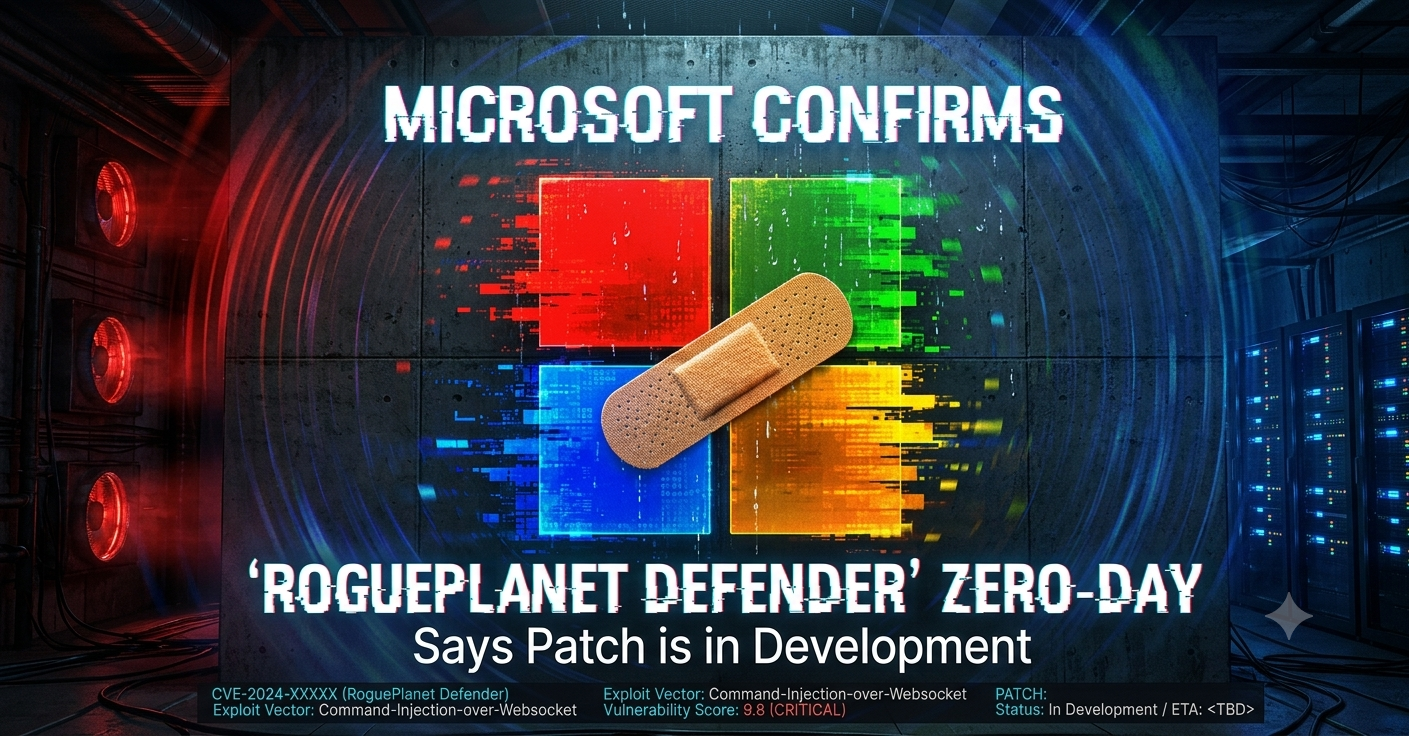
Microsoft has officially confirmed a critical zero-day local privilege escalation (LPE) vulnerability in the Microsoft Malware Protection Engine, designated as CVE-2026-50656. Codenamed “RoguePlanet,” the flaw allows a local attacker to execute a timing-based race condition exploit. If successful, this exploit bypasses active security controls to escalate user privileges to NT AUTHORITY\SYSTEM. The underlying Proof-of-Concept (PoC) functions effectively regardless of whether real-time protection is toggled on or active in passive mode. Microsoft is actively tracking the flaw and is developing an official high-quality security update to mitigate the active risk.
Introduction
The threat landscape surrounding native operating system security tools has shifted drastically over the past year. In a highly anticipated disclosure, Microsoft has formally acknowledged an unpatched zero-day vulnerability threatening its flagship security tool, Microsoft Defender. The local privilege escalation flaw, tracking under CVE-2026-50656, has been dubbed RoguePlanet by the cybersecurity community.
This flaw cuts straight to the core of endpoint visibility and defense. Security infrastructure software usually runs with the highest possible level of administrative authority to monitor process creation, access memory spaces, and scrub malicious files. However, this vast footprint means that any severe underlying flaw within the security application can easily be flipped into an attacker’s ultimate weapon. RoguePlanet represents exactly this scenario, giving unauthorized local users a reliable mechanism to seize total control over a host machine.
Background & Context
The RoguePlanet disclosure is not an isolated event. It represents the latest development in a targeted streak of vulnerability findings targeting the Microsoft Malware Protection Engine (mpengine.dll). The security researcher credited with discovering and releasing the PoC exploit code goes by the alias Chaotic Eclipse (also known across various developer channels as Nightmare-Eclipse).
Over the past several months, Chaotic Eclipse has systematically exposed structural weaknesses in the way Windows Defender handles internal processes, access privileges, and kernel communication channels. RoguePlanet is the fourth major Defender vulnerability exposed by this specific researcher within a short timeframe. It follows a distinct sequence of previously uncovered flaws, including:
- BlueHammer (CVE-2026-33825): A memory management flaw inside the scanning subsystem.
- UnDefend (CVE-2026-45498): An evasion vulnerability allowing malware payloads to blind specific hook routines.
- RedSun (CVE-2026-41091): An arbitrary file manipulation flaw within the signature updating service.
While Microsoft successfully developed and deployed official hotfixes for BlueHammer, UnDefend, and RedSun, RoguePlanet emerged as a surprise zero-day exploit dropped directly onto public repositories before a coordinated patch could be finalized. This aggressive release model has forced organizations worldwide to re-examine their defense-in-depth layouts while waiting for an official engine patch from the vendor.
Technical Breakdown
At its core, CVE-2026-50656 leverages a timing-dependent structural flaw known mathematically and computationally as a race condition. The vulnerability resides deep within the processing logic of the Microsoft Malware Protection Engine. When Windows Defender reads, locks, and analyzes file systems during an ongoing write operation, an unprivileged user can exploit a narrow window of processing delay.
The exploit manipulates specific file system symbolic links and junctions precisely at the millisecond the anti-malware engine attempts to verify file integrity and assign isolation permissions. By abusing this specific processing delay, an attacker can substitute a standard lower-privileged thread with an alternative thread containing malicious system instructions. Because the Malware Protection Engine naturally operates within the highest security context of the operating system, the system executes the swapped thread with complete administrative rights.
A unique feature of RoguePlanet is its complete indifference to defensive states. The researcher noted that the exploit bypasses standard endpoint protection layers effortlessly:
The PoC for RoguePlanet works regardless if real-time protection is on or not… It even works in the case of passive mode.
This occurs because the underlying vulnerability lies within the core scheduling architecture of the protection engine rather than its signature lookup tables or behavioral heuristics. Even when running in a minimized passive mode alongside a third-party antivirus provider, the vulnerable code elements remain accessible to local system queries.
Due to the nature of race conditions, the exploit can be inherently unpredictable. In testing environments, the vulnerability presents a variable exploitation rate:
The exploit is a race condition, so it’s a hit or miss. I have managed to get a 100% success rate on some machines while it struggled to work on others.
Factors influencing success include CPU core count, thread scheduling queues, memory load, and specific input/output disk speeds. However, even if a race condition fails on the initial attempt, a scripted attack loop can continually trigger the race state until execution succeeds, usually achieving the desired NT AUTHORITY\SYSTEM shell within seconds on a standard workstation.
Impact & Risk Assessment
The Common Vulnerability Scoring System (CVSS) v3 base score for CVE-2026-50656 is calculated at 7.8, reflecting a High-severity risk posture. While a score of 7.8 indicates that a vulnerability requires initial local access to be executed, the downstream operational impact of a successful exploit is severe.
In a modern enterprise setting, attackers rarely start with administrative control. Threat actors routinely gain their initial beachhead via phishing links, stolen employee credentials, or secondary software flaws. Once a low-level footprint is established, their primary objective is local privilege escalation. RoguePlanet provides exactly this capability.
A successful exploit completely destroys the local authorization boundary. By establishing a SYSTEM-level shell, an adversary can instantly execute several high-impact maneuvers:
- Credential Dumping: Extracting cleartext passwords or NTLM hashes directly from LSASS memory spaces.
- Defense Evasion: Terminating monitoring agents, disabling centralized logging hooks, or altering system event stores.
- Persistence Mechanisms: Installing rogue kernel-level drivers or modifying system boot configurations to ensure long-term network access.
- Lateral Movement: Utilizing administrative permissions to scan the broader enterprise network, harvest active session tokens, and compromise Domain Controllers.
Furthermore, because this zero-day targets the exact platform tasked with protecting the operating system, standard automated detection loops may fail to identify the malicious execution until the privilege shift has already concluded.
Vendor Response
Following the public dissemination of the PoC script by Chaotic Eclipse, Microsoft formally validated the security flaw, issuing an advisory acknowledging active engineering efforts to address the issue.
The official statement from the company emphasizes the importance of a coordinated remedy:
Microsoft is aware of an elevation of privilege in the Microsoft Malware Protection Engine in Microsoft Defender, publicly referred to as ‘RoguePlanet.’ We are working to provide a high-quality security update that addresses this vulnerability.
Engineers are currently auditing the file I/O operations inside mpengine.dll to introduce strict thread locking mechanisms and validation checks. These updates are intended to eliminate the timing window required to trigger the race condition safely. Because the Malware Protection Engine updates independently of standard monthly Windows quality patches, Microsoft intends to push this fix globally as soon as automated validation testing concludes across all supported OS builds.
Mitigations & Workarounds
Because an official binary patch is still under construction, security engineers must lean heavily on structural mitigations to lower their attack surface. Since RoguePlanet relies entirely on local code execution, locking down internal boundaries is the most effective approach.
1. Tighten Software Restriction Policies
Deploy AppLocker or Windows Defender Application Control (WDAC) policies to strictly block the execution of untrusted binaries, script variants, and unapproved executables inside user-writable profiles such as:
DOSC:\Users\*\AppData\Local\Temp\ C:\Users\Public\
2. Implement Strict Access Controls
Enforce the Principle of Least Privilege across all endpoints. Restrict standard enterprise users from executing command-line utilities like cmd.exe or powershell.exe unnecessarily. Turning off default administrative administrative tools for standard profiles heavily limits an attacker’s ability to run compiled exploit scripts smoothly.
3. Leverage User Account Control (UAC) Hardening
Configure UAC settings via Group Policy Object (GPO) to always prompt for credentials on a secure desktop environment. Ensure that even basic local actions require explicit verification, adding additional speed bumps to structural manipulation tools.
Detection & Monitoring
Defenders must look for telemetry patterns that indicate an actor is attempting to force a race condition against Windows Defender. Focus monitoring resources on the behavior of process spawns and unusual file access events.
Monitor Process Sub-Trees
A primary indicator of exploitation is the unusual creation of administrative shells originating from lower-privileged accounts. Monitor SIEM systems for unexpected parent-child relationships where system tools are invoked by non-standard users.
Parent Process: [Any User-Level Binary / Non-Admin Process]
Child Process: cmd.exe OR powershell.exe
Running Identity: NT AUTHORITY\SYSTEM
Audit Rapid File and Junction Modifications
Track high-volume, rapid creations of NTFS junctions, symbolic links, or hard links within user-controlled directories. Attackers attempting to hit the precise timing window of the race condition often run loops that quickly swap file paths. Frequent, rapid file handle requests aimed at paths currently being verified by MsMpEng.exe should trigger an immediate high-severity security alert.
Event Log Analysis
Analyze Windows Security Event Logs closely for Event ID 4688 (Process Creation). Pay special attention to tokens indicating elevated security profiles that don’t match standard operational workflows or automated system maintenance windows.
Best Practices
Defending against persistent zero-day researchers and shifting vulnerability landscapes requires keeping systems fundamentally clean and highly monitored.
- Maintain Endpoint Hygiene: Remove outdated software utilities and clean out unused development libraries from production machines. This significantly reduces the availability of local tools that attackers can abuse to compile or run raw exploit scripts.
- Segment Networks Continuously: Assume your endpoints will eventually be compromised. Use strict internal network isolation policies to ensure that an attacker gaining a local SYSTEM shell on a single workstation cannot seamlessly jump to high-value infrastructure assets.
- Centralize Log Collections: Ensure all process monitoring records, PowerShell logging strings, and security event logs are instantly shipped to an immutable off-site repository. This keeps your visibility intact even if an attacker manages to clear local event logs using escalated privileges.
Key Takeaways
CVE-2026-50656 serves as a stark reminder that even your core security tools can introduce unexpected entry points if their underlying logic is manipulated correctly. Relying on a single defensive agent to protect an entire enterprise leaves an organization highly vulnerable to targeted research discoveries.
While waiting for Microsoft’s official engine patch, security teams must focus heavily on blocking initial access vectors, monitoring for unusual process elevations, and applying strict application control layers to defuse the exploit before it can run.
References
- Microsoft Security Advisory: CVE-2026-50656 (Defender Elevation of Privilege Vulnerability)
- The Hacker News: “Microsoft Confirms RoguePlanet Defender Zero-Day, Says Patch is in Development” (June 2026)
- Chaotic Eclipse Security Research Repository: Technical Notes on RoguePlanet Race Conditions
- Mitre ATT&CK Framework: T1068 (Exploitation for Privilege Escalation)
Stay updated at https://cydhaal.com — Your Daily Dose of Cyber Intelligence.
📧 Subscribe to our newsletter at https://cydhaal.com/newsletter/