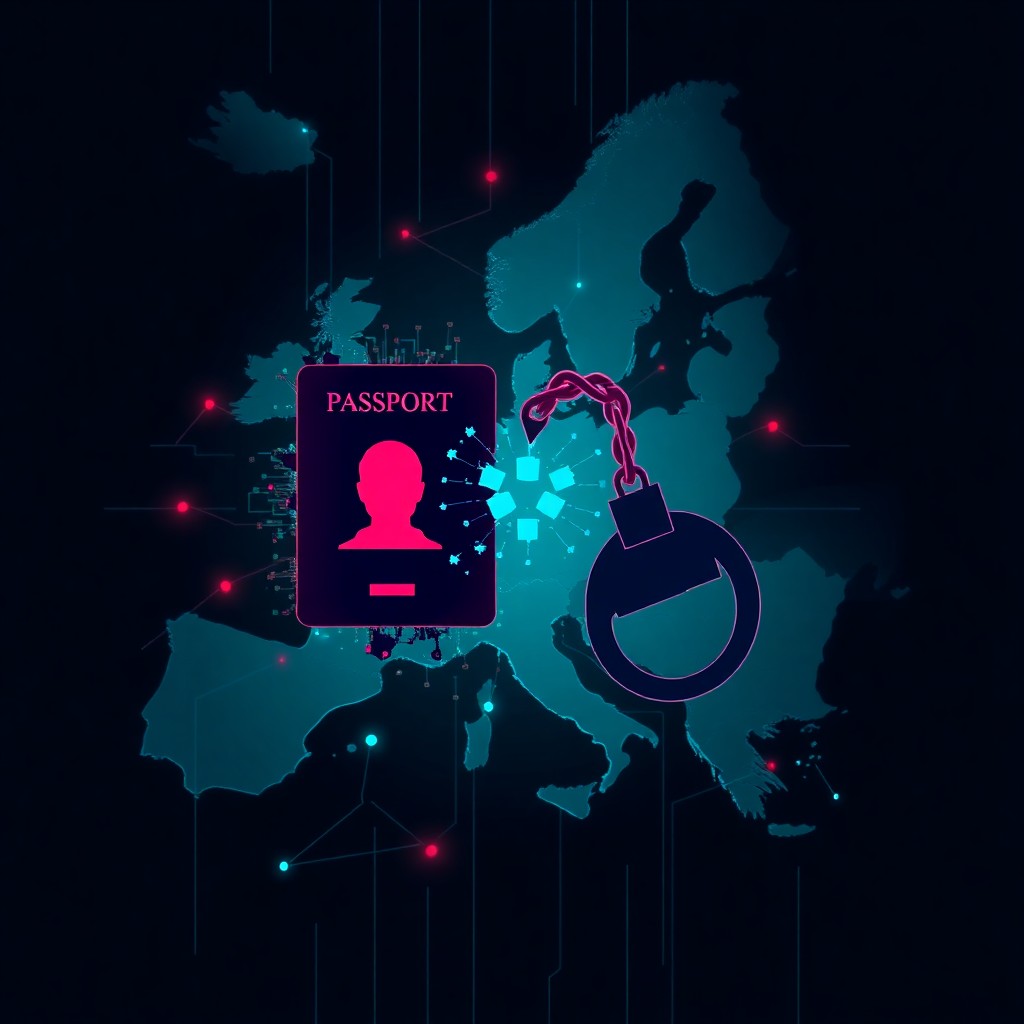
European law enforcement agencies successfully dismantled a sophisticated online marketplace specializing in fraudulent identity documents used predominantly by migrant smuggling operations. The operation, coordinated across multiple jurisdictions, resulted in arrests, server seizures, and the disruption of a criminal infrastructure that facilitated illegal border crossings and identity fraud on a continental scale. This marketplace enabled organized crime groups to provide counterfeit passports, ID cards, and residency permits to individuals seeking to bypass immigration controls.
Introduction
In a coordinated multinational operation, European police forces have taken down a clandestine online marketplace that served as a one-stop shop for fraudulent identity documents. The platform, which operated on both the clear web and darker corners of the internet, catered primarily to migrant smuggling networks seeking to equip their clients with convincing fake IDs to circumvent border security measures.
The investigation exposed a sophisticated criminal ecosystem where document forgery met modern e-commerce convenience. Customers could browse catalogs of counterfeit documents from dozens of countries, complete with quality ratings, pricing tiers, and customer reviews—all while the platform processed thousands of orders worth millions of euros annually.
This operation highlights the evolving intersection between cybercrime infrastructure and traditional organized crime, where digital platforms enable and scale physical criminal activities across international borders.
Background & Context
Fake identity document marketplaces have proliferated alongside the growth of encrypted communications and cryptocurrency payments. These platforms traditionally served various criminal purposes: enabling financial fraud, identity theft, underage access to restricted services, and facilitating other illicit activities.
However, recent years have seen specialized marketplaces emerge focusing specifically on migration-related documents. The European migrant crisis created substantial demand for documents that could help individuals either enter European countries illegally or establish false identities once inside EU borders.
These marketplaces operate with surprising sophistication. Vendors offer different quality tiers—from basic photo substitutions on legitimate document templates to fully registered documents created through corrupted officials or breaches of government document issuance systems. Premium offerings include documents with genuinely registered numbers that can pass automated verification systems.
The criminal infrastructure supporting these operations involves multiple specialized roles: graphic designers who replicate security features, printers with access to specialized equipment, corrupt officials who provide genuine document templates or database access, logistics networks for delivery, and the platform operators themselves who facilitate transactions and manage vendor relationships.
Law enforcement agencies across Europe had been tracking this particular marketplace for approximately 18 months, building a comprehensive intelligence picture of its operations, key administrators, primary vendors, and customer base before initiating the takedown operation.
Technical Breakdown
The marketplace operated using a hybrid infrastructure model. While initial contact and marketing occurred through encrypted messaging applications like Telegram and WhatsApp, the actual ordering platform existed as a hidden service accessible through standard web browsers with specific links shared only through vetted channels.
The platform employed several security measures to protect its operations:
Operational Security Layers:
- Multi-tier access control requiring referrals from existing customers
- Cryptocurrency-only payments (primarily Bitcoin and Monero)
- Automated message destruction for order communications
- Geographic restrictions blocking access from certain IP ranges
- Compartmentalized vendor accounts preventing full platform visibility
Document Production Pipeline:
The investigation revealed a distributed production model where:
- Customers submitted orders through the web portal with required biographical information and photographs
- Orders were distributed to specialized vendors based on document type and destination country
- Vendors produced documents using high-quality printers, holographic overlays, and security feature replication
- Completed documents were shipped through compromised logistics channels or dead-drop networks
- Payment was released from escrow after customer confirmation
The marketplace database, seized during the operation, contained over 60,000 customer records, 234 vendor accounts, and transaction records indicating approximately €15 million in processed orders over a three-year operational period.
Forensic analysis revealed that the platform operators maintained detailed records—contradicting the promised security—which proved invaluable for investigators. Server logs, customer communications, vendor details, and financial flows were all recoverable from the seized infrastructure.
Impact & Risk Assessment
The dismantling of this marketplace represents a significant disruption to migrant smuggling operations across Europe, but the broader implications extend into multiple threat domains:
Immediate Impacts:
- Disruption of document supply chains for organized smuggling networks
- Potential identification and apprehension of marketplace customers through seized records
- Loss of criminal infrastructure representing years of development and reputation building
- Financial losses for vendors with escrowed funds seized
Broader Security Implications:
The fraudulent documents produced through this marketplace enabled various downstream criminal activities beyond illegal migration. Fake identities facilitated money laundering, tax evasion, benefits fraud, and enabled individuals with criminal backgrounds or terrorist connections to evade law enforcement tracking.
Border security systems across Europe were potentially compromised by documents sophisticated enough to pass initial inspection. Several seized documents included genuinely registered numbers obtained through database breaches or corrupt officials, meaning they could verify as legitimate in automated checking systems.
Residual Risks:
The marketplace takedown does not eliminate the underlying demand. Alternative platforms will likely emerge to fill the vacuum, potentially with improved security measures learned from this operation’s failure. The customer database seizure may actually increase risks for affected individuals who may become targets for extortion or further law enforcement action.
Vendor Response
As this incident involves criminal marketplace infrastructure rather than legitimate technology vendors, there is no traditional vendor response. However, government agencies and international law enforcement organizations have issued statements:
Europol Statement:
Europol coordinated the operation across nine European countries, emphasizing the investigation’s success in dismantling not just the platform but arresting 27 individuals including marketplace administrators, primary vendors, and logistics coordinators. The agency highlighted the operation as demonstrating effective international cooperation against transnational organized crime leveraging cyber infrastructure.
National Police Forces:
Participating agencies from Germany, France, Spain, Belgium, Netherlands, Italy, Greece, Poland, and Austria conducted simultaneous raids resulting in server seizures, arrests, and evidence collection. Several agencies indicated that follow-up investigations targeting customers and secondary networks remain ongoing.
Border Security Agencies:
Multiple European border security agencies received intelligence packages containing details of compromised document numbers, vendor techniques, and security feature replication methods to improve document verification procedures at border crossings.
Mitigations & Workarounds
For border security and immigration authorities, several mitigation strategies emerge from this investigation:
Enhanced Document Verification:
Document Inspection Protocol:
- Physical security feature examination under UV/infrared
- Database verification of document registration numbers
- Biometric cross-referencing where available
- Behavioral assessment during document presentation
- Secondary review for high-risk origin documents
Intelligence Integration:
Border control systems should incorporate threat intelligence about known compromised document numbers, vendor techniques, and common fraudulent document patterns identified through marketplace seizures.
Corruption Prevention:
The investigation revealed that some fraudulent documents originated from corrupt officials within document issuance systems. Enhanced internal security, audit procedures, and anomaly detection in document issuance systems can reduce this vulnerability.
Inter-Agency Coordination:
Information sharing between immigration authorities, law enforcement, and intelligence agencies enables faster identification of fraudulent document networks and their customers.
Detection & Monitoring
Law enforcement agencies can detect similar marketplace operations through several monitoring strategies:
Digital Footprint Analysis:
# Indicators of marketplace infrastructure:
- Hosting patterns matching known criminal infrastructure
- Cryptocurrency wallet clustering and transaction flow analysis
- Encrypted messaging channel monitoring for marketplace advertisements
- Dark web crawling for document vendor advertisements
- Domain registration pattern analysis
Financial Monitoring:
Cryptocurrency blockchain analysis can identify payment flows associated with document fraud operations. Transaction patterns, wallet clustering, and exchange interactions provide investigative leads.
Physical Document Analysis:
Systematic analysis of intercepted fraudulent documents can reveal common production sources, vendor-specific characteristics, and supply chain patterns that point back to marketplace operations.
Human Intelligence:
Infiltration of smuggling networks and customer communities provides intelligence about marketplace locations, access methods, and operational patterns that purely technical monitoring cannot reveal.
Best Practices
For law enforcement and border security agencies combating document fraud ecosystems:
Proactive Intelligence Development:
- Maintain dedicated units monitoring online document fraud marketplaces
- Develop informant networks within smuggling and fraud communities
- Participate in international information-sharing frameworks
- Conduct regular assessments of document security vulnerabilities
Technology Enhancement:
- Implement advanced biometric verification at border crossings
- Deploy AI-powered document authentication systems
- Maintain updated databases of security features for all document types
- Utilize blockchain or distributed ledger systems for document verification
International Cooperation:
Document fraud crosses borders by definition, requiring coordinated multinational responses. Regular joint operations, shared intelligence databases, and harmonized legal frameworks enable more effective disruption of these criminal networks.
Addressing Root Causes:
While law enforcement operations disrupt criminal infrastructure, addressing the underlying demand for fraudulent documents requires comprehensive migration policy approaches, legal pathways for asylum seekers, and economic development in source regions.
Key Takeaways
- European police successfully dismantled a major fake ID marketplace serving migrant smuggling networks through coordinated multinational operations
- The platform processed approximately €15 million in fraudulent document orders over three years, with 60,000+ customer records seized
- The operation demonstrates the convergence of cybercrime infrastructure with traditional organized crime activities
- Sophisticated document fraud operations employ distributed production models, cryptocurrency payments, and encrypted communications
- Seized databases provide ongoing investigative value but don’t eliminate underlying demand
- Enhanced document verification, intelligence sharing, and international cooperation are essential for combating these criminal ecosystems
- Alternative marketplaces will likely emerge, requiring sustained law enforcement attention and improved counter-fraud technologies
References
- Europol Press Release: Multi-country Operation Against Document Fraud Networks
- National Police Agency Reports (Germany, France, Spain)
- International Centre for Migration Policy Development: Document Fraud Trends
- Border Security Agency Intelligence Briefings
- Cryptocurrency Blockchain Analysis Reports on Criminal Payment Networks
Stay updated at https://cydhaal.com — Your Daily Dose of Cyber Intelligence.
📧 Subscribe to our newsletter at https://cydhaal.com/newsletter/