









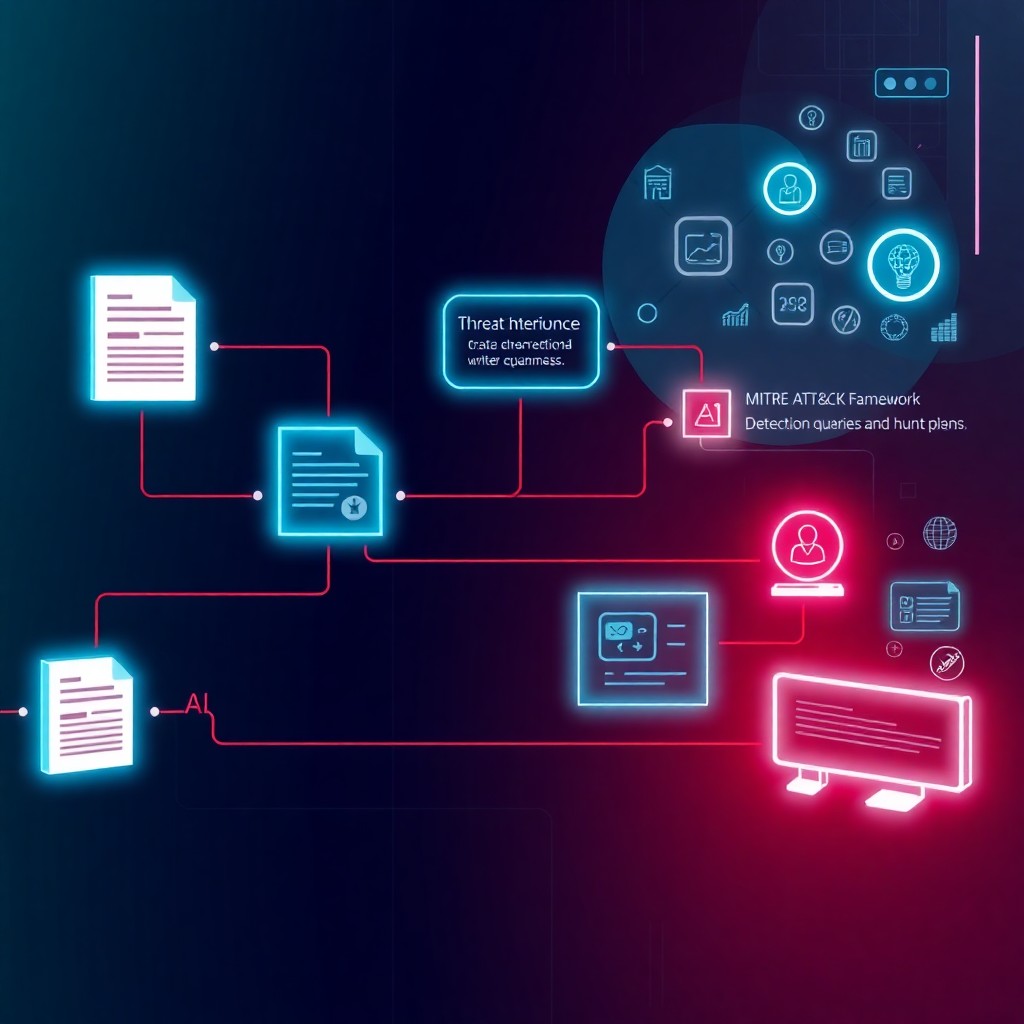
Security teams are bridging the gap between threat intelligence consumption and proactive threat hunting through automated pipelines that transform raw intelligence feeds into actionable hunt plans. These systems parse indicators of compromise (IOCs), tactics, techniques, and procedures (TTPs), and threat actor profiles to generate structured hunting queries, detection rules, and investigation playbooks. By automating the translation of intelligence into executable searches across SIEM, EDR, and network monitoring platforms, organizations can significantly reduce the time between threat discovery and defensive action while scaling their security operations.
Introduction
Threat intelligence has long promised to give defenders an advantage against adversaries, yet many organizations struggle to operationalize the vast amounts of data they receive. Security analysts often face an overwhelming flood of threat reports, IOC feeds, and vulnerability disclosures without clear guidance on how to hunt for these threats in their own environments.
The emergence of automated threat hunting pipelines represents a paradigm shift in how organizations consume and act upon threat intelligence. Rather than manually translating intelligence reports into hunt hypotheses and detection logic, these systems automatically generate ready-to-execute hunt plans tailored to an organization’s specific technology stack and threat landscape. This automation enables security teams to move from reactive alerting to proactive threat discovery at scale.
Background & Context
Traditional threat intelligence workflows suffer from several critical bottlenecks. Analysts must manually review intelligence reports, extract relevant IOCs and TTPs, map them to frameworks like MITRE ATT&CK, translate them into platform-specific query languages, and finally execute searches across disparate security tools. This process can take hours or days, during which time threats may already be active within the environment.
The concept of threat hunting emerged as a proactive complement to automated detection systems. Unlike passive monitoring that waits for alerts, hunting involves actively searching for signs of compromise based on hypotheses about adversary behavior. However, effective hunting requires deep knowledge of both threat actor methodologies and the technical query languages of security platforms.
Recent advances in security orchestration, automation, and response (SOAR) technologies, combined with standardized threat intelligence formats like STIX/TAXII and the widespread adoption of the MITRE ATT&CK framework, have created the foundation for automated hunt plan generation. These pipelines can now ingest intelligence from multiple sources, normalize the data, and output platform-specific hunting queries and detection rules.
Technical Breakdown
Automated threat hunting pipelines typically consist of several interconnected components working in concert to transform raw intelligence into actionable hunt plans.
Intelligence Ingestion Layer
The pipeline begins by collecting threat intelligence from diverse sources including commercial feeds, open-source intelligence (OSINT), information sharing and analysis centers (ISACs), and internal incident data. The ingestion layer normalizes this data into a common format, often using STIX 2.0 or similar standards.
intelligence_sources:
  - type: STIX_FEED
    url: https://threat-feed.example.com/stix2
    priority: high
  - type: MISP_INSTANCE
    endpoint: https://misp.internal.corp
    priority: medium
  - type: CUSTOM_API
    source: threat_vendor_alpha
    format: json
Enrichment and Contextualization Engine
Raw intelligence is enriched with additional context about the organization’s environment, asset inventory, and previous incidents. The system determines which threats are relevant based on the technologies deployed, geographic presence, industry sector, and historical targeting patterns.
ATT&CK Mapping Module
The system automatically maps threat intelligence to specific MITRE ATT&CK techniques, creating a structured representation of adversary behavior. This mapping enables the pipeline to understand not just individual IOCs but complete attack chains.
def map_threat_to_attack(threat_intel):
    techniques = []
    for behavior in threat_intel['behaviors']:
        matched = attack_framework.find_technique(
            description=behavior['description'],
            platform=behavior['platform']
        )
        techniques.append({
            'technique_id': matched.id,
            'tactic': matched.tactic,
            'confidence': matched.confidence_score
        })
    return techniques
Query Generation Engine
This core component translates ATT&CK techniques and IOCs into platform-specific hunting queries. The engine maintains templates for various security tools (Splunk, Elastic, Microsoft Sentinel, CrowdStrike, etc.) and generates syntactically correct queries optimized for each platform.
-- Auto-generated hunt query for T1003.001 (LSASS Memory Dumping)
SELECT
    timestamp,
    hostname,
    process_name,
    command_line,
    parent_process
FROM process_events
WHERE (process_name LIKE '%procdump%' OR
       process_name LIKE '%mimikatz%' OR
       command_line LIKE '%lsass%')
    AND timestamp > NOW() - INTERVAL '7 days'
ORDER BY timestamp DESC;
Hunt Plan Orchestration
The final component packages queries with investigation procedures, expected baselines, false positive guidance, and escalation paths into complete hunt plans. These plans include sequenced queries that follow attack progression and provide context for interpreting results.
Impact & Risk Assessment
Organizations implementing automated threat hunting pipelines report significant improvements in their security posture and operational efficiency. The primary benefits include:
Reduced Time-to-Hunt: The interval between threat intelligence publication and active hunting drops from days to minutes. When a new ransomware variant is disclosed, the pipeline can generate and execute relevant queries across the environment within the hour.
Increased Hunt Coverage: Automation enables security teams to investigate a broader range of threats. Teams that previously conducted 5-10 manual hunts per month can now execute hundreds of automated hunts, dramatically improving threat coverage.
Skill Gap Mitigation: Junior analysts can execute sophisticated hunts without mastering complex query languages or deeply understanding every threat actor’s methodology. The pipeline codifies expert knowledge into repeatable processes.
Consistency and Documentation: Automated pipelines ensure consistent methodology across hunts and automatically document what was searched, when, and what was found, improving audit trails and compliance posture.
However, organizations must also consider potential risks. Over-reliance on automation without human oversight can lead to missed detections if the pipeline incorrectly interprets intelligence or generates flawed queries. Performance impacts on production systems from aggressive automated hunting must be carefully managed.
Vendor Response
The cybersecurity industry has responded to demand for automated threat hunting with various solutions. Major SIEM and XDR vendors have integrated threat intelligence-driven hunting capabilities into their platforms. Microsoft Sentinel offers threat intelligence integration with automatic hunt query suggestions. Splunk’s Security Essentials provides pre-packaged detection content linked to threat intelligence feeds.
Specialized vendors like ThreatQuotient, Anomali, and Recorded Future have developed dedicated threat intelligence platforms with hunting automation features. These solutions focus on intelligence management, enrichment, and operationalization across multiple security tools.
Open-source projects have also emerged to democratize this capability. The MITRE Cyber Analytics Repository (CAR) provides analytics mapped to ATT&CK, while projects like Sigma enable universal detection rule formats that can be translated to multiple SIEM platforms.
Security orchestration platforms from Palo Alto (Cortex XSOAR), Splunk (SOAR), and IBM (Resilient) have incorporated threat hunting workflow automation, allowing organizations to build custom pipelines tailored to their specific requirements.
Mitigations & Workarounds
For organizations without mature threat intelligence programs, several approaches can help build toward automated threat hunting:
Start with ATT&CK-Based Hunts: Focus initial automation efforts on high-priority ATT&CK techniques relevant to your threat profile rather than trying to operationalize all intelligence feeds simultaneously.
Implement Staged Rollout: Begin with read-only hunt execution that generates reports for analyst review before progressing to automated response actions.
Leverage Existing Detection Content: Utilize vendor-provided and community detection rules as a foundation, then customize based on threat intelligence specific to your organization.
Establish Feedback Loops: Ensure hunt results feed back into the intelligence pipeline to improve relevance scoring and reduce false positives over time.
Organizations lacking resources for full automation can achieve partial benefits through semi-automated workflows where analysts review auto-generated hunt plans before execution.
Detection & Monitoring
Ironically, the threat hunting pipeline itself requires monitoring to ensure effectiveness and prevent operational issues.
Pipeline Health Monitoring: Track intelligence feed availability, processing latency, and query generation success rates to identify pipeline degradation.
pipeline_metrics = {
    'feeds_processed_24h': 847,
    'queries_generated': 1203,
    'queries_executed': 1198,
    'execution_failures': 5,
    'avg_query_runtime': '4.3s',
    'hunts_with_findings': 23
}
Hunt Effectiveness Metrics: Measure true positive rates, false positive rates, and time-to-detection for threats discovered through automated hunts versus traditional alerts.
Resource Impact Monitoring: Track CPU, memory, and network utilization impacts from hunt queries to prevent degradation of production systems or security tool performance.
Coverage Gap Analysis: Regularly assess which ATT&CK techniques are covered by automated hunts and identify blind spots requiring manual hunt development.
Best Practices
Organizations implementing automated threat hunting pipelines should follow these practices to maximize effectiveness:
Prioritize Intelligence Quality Over Quantity: Focus on curated, high-fidelity intelligence sources relevant to your threat landscape rather than ingesting every available feed. More data creates noise that degrades automation effectiveness.
Maintain Human-in-the-Loop Oversight: Automation should augment, not replace, human hunters. Schedule regular reviews of auto-generated queries and hunt results to identify logic errors or missed nuances.
Tune for Your Environment: Generic hunt queries produce excessive false positives. Customize queries with environment-specific baselines, whitelists for known-good behavior, and context from asset management systems.
Document Expected Outcomes: Each hunt plan should include baseline expectations and guidance on interpreting results. This helps analysts distinguish normal variations from genuine threats.
Integrate with Incident Response: Ensure hunt findings automatically generate cases in your incident response workflow with appropriate severity and context for efficient triage.
Test Query Performance: Validate that auto-generated queries perform efficiently at scale before deploying to production. Poorly optimized queries can overwhelm security infrastructure.
Version Control Hunt Logic: Treat hunt queries and pipeline configurations as code, maintaining version history and change logs to support troubleshooting and compliance requirements.
Key Takeaways
- Automated threat hunting pipelines bridge the critical gap between consuming threat intelligence and taking action, reducing time-to-hunt from days to minutes
- These systems transform raw intelligence into platform-specific queries, detection rules, and complete investigation playbooks without manual translation
- Organizations can dramatically scale their proactive threat discovery capabilities while mitigating skill gaps within security teams
- Successful implementation requires balancing automation with human oversight, focusing on intelligence quality, and continuous tuning for environment-specific context
- The technology is rapidly maturing with solutions available from major security vendors, specialized platforms, and open-source projects
- Measuring pipeline effectiveness through hunt coverage metrics, detection rates, and resource impact ensures continuous improvement
Stay updated at https://cydhaal.com — Your Daily Dose of Cyber Intelligence.
📧 Subscribe to our newsletter at https://cydhaal.com/newsletter/