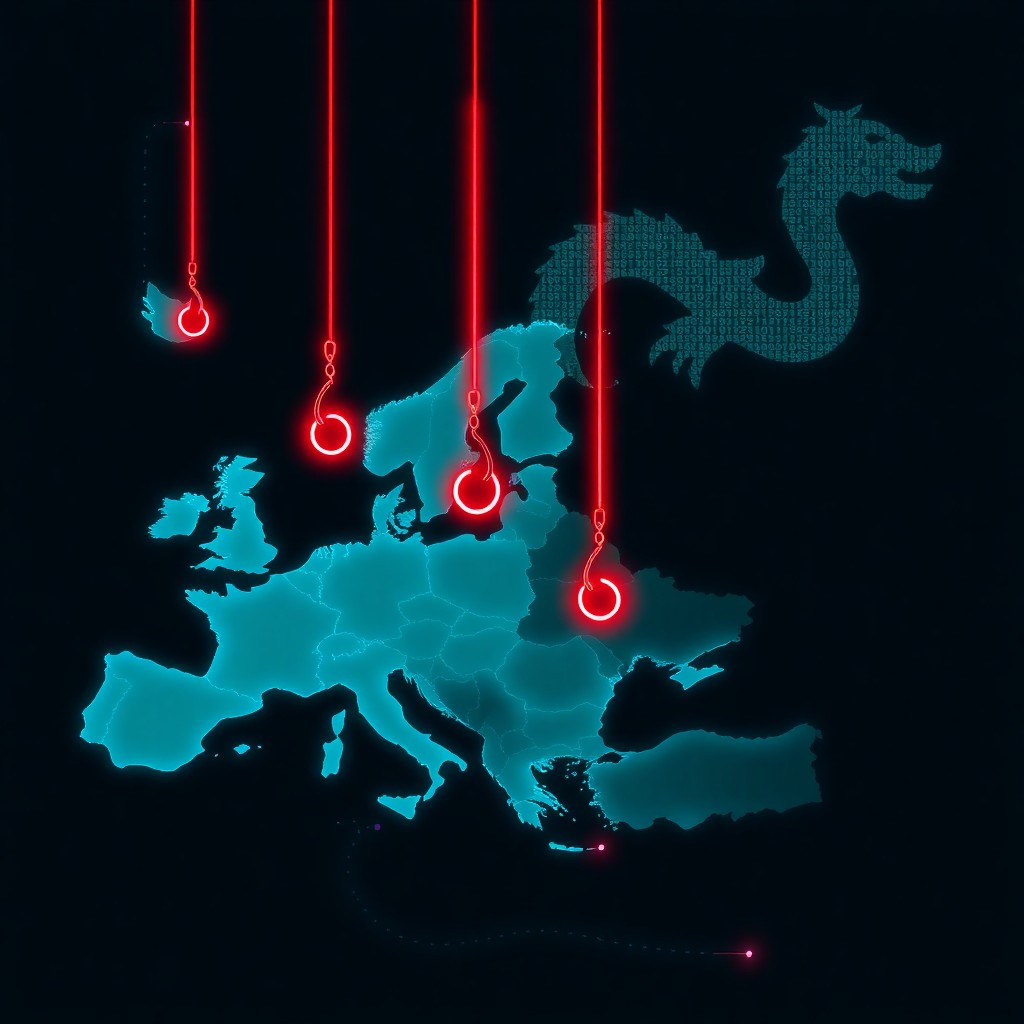
Chinese state-sponsored threat actor TA4922 has broadened its phishing campaign beyond traditional targets, now hitting organizations in the United Kingdom, Germany, Italy, and South Africa. The group deploys sophisticated credential harvesting infrastructure using compromised legitimate domains and QR code-based lures to evade detection. Organizations across government, defense, technology, and manufacturing sectors face elevated risk as this APT group demonstrates evolving tradecraft and geographical expansion.
Introduction
A China-linked advanced persistent threat (APT) group tracked as TA4922 has significantly expanded its operational footprint, launching coordinated phishing attacks across multiple European nations and Africa. First identified targeting Asian diplomatic and government entities, the group’s pivot to Western Europe and South Africa signals a strategic shift in Chinese cyber espionage priorities.
This expansion coincides with heightened geopolitical tensions and represents a calculated effort to compromise organizations handling sensitive information related to defense, technology transfer, and critical infrastructure. The campaign’s sophistication—combining legitimate infrastructure abuse, mobile-targeting techniques, and traditional spear-phishing—demonstrates TA4922’s evolution as a mature threat actor capable of adapting to diverse target environments.
Background & Context
TA4922 emerged on the threat landscape in early 2023, initially focusing operations on Southeast Asian government ministries and diplomatic missions. Intelligence suggests the group operates with objectives aligned with China’s strategic intelligence collection priorities, particularly regarding Belt and Road Initiative partners and regional security matters.
The group shares tactical overlaps with known Chinese APT clusters including APT41 and Mustang Panda, though maintains distinct infrastructure and targeting patterns. Previous campaigns employed spear-phishing with geopolitical lures, weaponized documents, and credential harvesting portals mimicking legitimate government authentication systems.
The current European expansion represents the group’s most ambitious campaign to date. Targeting patterns suggest intelligence collection focused on NATO member states, EU policymaking bodies, and defense contractors supporting Ukraine. The inclusion of South Africa—a BRICS nation with complex China relations—indicates multifaceted strategic intelligence requirements driving the operation.
Technical Breakdown
TA4922’s current campaign employs a multi-stage phishing infrastructure designed to harvest credentials while maintaining operational security.
Initial Compromise Vector
Phishing emails impersonate legitimate government agencies, defense contractors, and international organizations. Messages leverage urgent geopolitical themes—energy security, trade regulations, defense cooperation—appropriate to each target geography. Lures reference genuine policy initiatives and current events to enhance credibility.
The emails contain either:
- QR codes directing mobile users to credential harvesting pages
- HTML attachments with embedded redirects
- Shortened URLs masquerading as document sharing links
Infrastructure Architecture
TA4922 compromises legitimate small business and personal websites to host phishing infrastructure. Observed compromised domains include:
- Regional WordPress sites with outdated plugins
- Personal blogs running vulnerable CMS platforms
- Small business websites lacking active security monitoring
The group deploys PHP-based credential harvesting kits on these compromised hosts:
// Example obfuscated harvesting pattern observed
 $_POST['email'],
               'pass' => $_POST['password']);
file_put_contents('dat.txt', json_encode($creds), FILE_APPEND);
header("Location: " . $target);
?>
Harvested credentials are exfiltrated to command-and-control infrastructure hosted on bulletproof hosting providers in jurisdictions with limited law enforcement cooperation.
Evasion Techniques
The group employs multiple detection evasion strategies:
Geographic Filtering: Phishing pages check visitor IP addresses, displaying content only to targets in specific countries while showing benign content to security researchers.
User-Agent Validation: Sites detect automated scanning tools and security sandboxes, returning HTTP 404 responses to analysis infrastructure.
Time-Limited Links: Phishing URLs remain active for 24-48 hours before the group removes infrastructure, limiting forensic analysis opportunities.
Mobile-First Targeting: QR codes specifically target mobile devices where security controls are typically weaker and users less cautious.
Impact & Risk Assessment
Organizational Risk
Organizations in affected regions face significant compromise risk. Successful credential harvesting enables:
- Unauthorized access to email systems containing sensitive communications
- Lateral movement within compromised networks
- Intellectual property theft from research and development systems
- Long-term persistent access for ongoing intelligence collection
Defense contractors and government agencies face particularly acute risks given the group’s intelligence collection mandate.
Sector-Specific Threats
Defense Industry: Contractors supporting European defense modernization and Ukraine assistance programs represent high-value targets for Chinese intelligence collection.
Technology Sector: Companies involved in semiconductor manufacturing, AI development, and telecommunications infrastructure face risks of technology transfer and industrial espionage.
Government Agencies: Diplomatic communications, policy development materials, and classified information handling systems remain primary intelligence targets.
Manufacturing: Organizations involved in critical supply chains or dual-use technology production face compromise risks.
Strategic Implications
The campaign’s European expansion indicates Chinese intelligence priorities extending beyond traditional Asia-Pacific focus areas. Organizations should anticipate sustained targeting as geopolitical tensions persist.
Vendor Response
Multiple cybersecurity vendors have published threat intelligence on TA4922’s expanded operations. Email security providers have updated detection signatures to identify campaign-specific indicators.
European national cybersecurity agencies including the UK’s National Cyber Security Centre (NCSC), Germany’s BSI, and Italy’s ACN have issued advisories warning organizations about the increased threat activity.
No official attribution has been made by government agencies, though private sector intelligence firms assess with high confidence that TA4922 operates in support of Chinese state intelligence objectives.
Cloud service providers have taken down identified phishing infrastructure hosted on their platforms, though the group continues registering new domains and compromising additional websites.
Mitigations & Workarounds
Organizations should implement immediate defensive measures:
Email Security Hardening
Configure SPF, DKIM, and DMARC policies to prevent domain spoofing:
v=DMARC1; p=quarantine; rua=mailto:dmarc@yourdomain.com; pct=100; adkim=s; aspf=sDeploy advanced email filtering solutions capable of analyzing:
- QR code content extraction and URL analysis
- HTML attachment sandboxing
- Behavioral anomaly detection
Credential Protection
Implement phishing-resistant multi-factor authentication across all systems:
- FIDO2 hardware security keys
- WebAuthn-based authentication
- Certificate-based authentication for privileged accounts
Deploy password managers to reduce manual credential entry and phishing susceptibility.
Mobile Device Management
Given the QR code targeting vector, organizations must:
- Enforce mobile device management (MDM) solutions
- Require enterprise browsers with phishing protection
- Implement conditional access policies restricting mobile device access to sensitive resources
- Conduct mobile-specific security awareness training
Network Segmentation
Assume breach mentality requires limiting lateral movement opportunities:
- Implement zero-trust network architecture
- Segment critical systems from general corporate networks
- Monitor East-West traffic patterns for anomalies
Detection & Monitoring
Email-Based Indicators
Monitor for suspicious email characteristics:
- Urgent geopolitical themes inappropriate to recipient role
- Requests to scan QR codes for “secure document access”
- Shortened URLs from services like bit.ly, tinyurl, or similar
- HTML attachments from unexpected senders
- Domain spoofing attempts mimicking government agencies
Network Detection
Implement monitoring for:
# Example Suricata rule for credential harvesting detection
alert http any any -> any any (msg:"Possible TA4922 Credential Harvesting";
  content:"POST"; http_method;
  content:"password"; http_client_body;
  content:"email"; http_client_body;
  pcre:"/ref=[A-Za-z0-9+\/=]{20,}/";
  sid:1000001; rev:1;)
Monitor DNS queries for newly registered domains and recently compromised legitimate sites exhibiting unusual traffic patterns.
Authentication Monitoring
Deploy User and Entity Behavior Analytics (UEBA) to detect:
- Authentication attempts from unusual geographic locations
- Multiple failed login attempts followed by success
- Access to sensitive resources from mobile devices
- Unusual access time patterns
Enable detailed authentication logging and integrate with SIEM platforms for correlation analysis.
Best Practices
Security Awareness Training
Conduct targeted training addressing:
- QR code phishing risks specific to mobile devices
- Geopolitical lure recognition appropriate to organizational context
- Verification procedures before accessing external links
- Incident reporting processes for suspicious communications
Threat Intelligence Integration
Subscribe to threat intelligence feeds covering Chinese APT activity. Integrate indicators of compromise into security infrastructure:
# Example: Updating firewall with known malicious IPs
curl -s https://threatfeed.example.com/ta4922-iocs.txt | \
  while read ip; do
    iptables -A INPUT -s $ip -j DROP
  done
Participate in information sharing organizations relevant to your sector and geography.
Incident Response Preparedness
Develop and exercise incident response playbooks specifically addressing:
- Credential compromise scenarios
- APT-level threat actor engagement
- Coordination with national cybersecurity agencies
- Evidence preservation for law enforcement
Maintain relationships with external incident response partners capable of APT-level threat hunting and forensics.
Privileged Access Management
Implement just-in-time privileged access with:
- Time-limited credential issuance
- Session recording for privileged access
- Automated credential rotation
- Separate administrative accounts from standard user accounts
Key Takeaways
- TA4922’s European expansion represents a significant escalation in Chinese APT operations beyond traditional Asia-Pacific focus areas
- QR code-based mobile phishing represents an evolving threat vector requiring updated defensive strategies
- Organizations in defense, technology, government, and manufacturing sectors face elevated targeting risk
- Phishing-resistant MFA implementation provides the most effective single control against credential harvesting
- Comprehensive detection requires integration of email security, network monitoring, and authentication analytics
- The campaign’s sophisticated infrastructure and evasion techniques indicate a well-resourced, mature threat actor
- International coordination and information sharing remain critical for effective defense against nation-state threats
References
- Proofpoint Threat Intelligence – TA4922 Campaign Analysis
- UK National Cyber Security Centre – Advisory on Chinese APT Activity
- Recorded Future – Chinese State-Sponsored Cyber Operations in Europe
- MITRE ATT&CK Framework – T1566 (Phishing) and T1078 (Valid Accounts)
- European Union Agency for Cybersecurity (ENISA) – Threat Landscape Report
- Mandiant Intelligence – APT Groups Targeting European Organizations
Stay updated at https://cydhaal.com — Your Daily Dose of Cyber Intelligence.
📧 Subscribe to our newsletter at https://cydhaal.com/newsletter/