







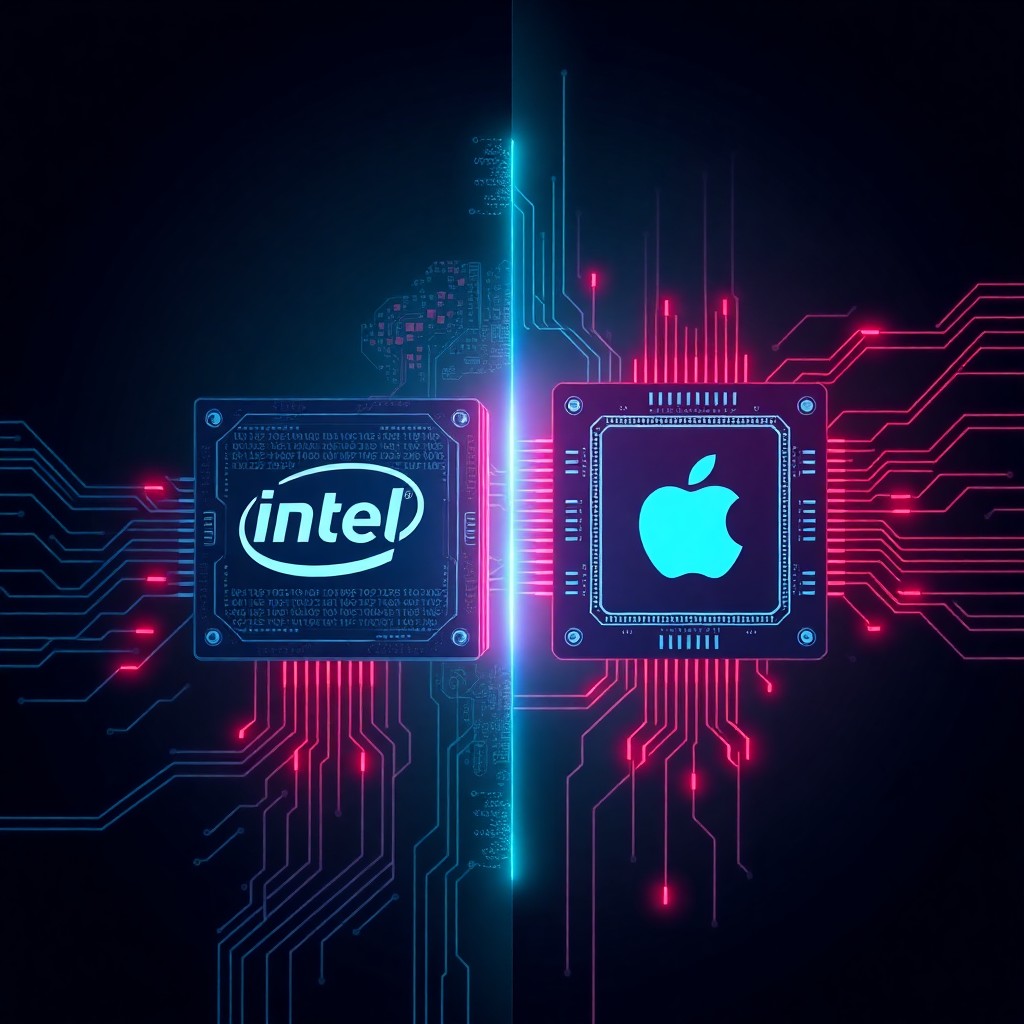
Two decades after Apple’s historic transition to Intel processors in 2006, the company has come full circle by moving to its own Apple Silicon chips. This journey reveals a fascinating evolution in hardware security architecture, from the limited protections of PowerPC Macs through Intel’s x86 vulnerabilities, to Apple’s current custom silicon with security-first design. The switch to Intel brought performance gains but exposed Macs to decades of x86 security flaws, while the transition to Apple Silicon enabled unprecedented hardware-level security controls that fundamentally changed macOS threat modeling.
Introduction
January 2006 marked a seismic shift in Apple’s history when the first Intel-based Macs shipped to consumers. For 20 years, Apple rode the Intel wave, benefiting from x86 performance improvements while inheriting its security baggage. By 2020, Apple had pivoted again—this time to custom ARM-based processors called Apple Silicon. Understanding this two-decade journey isn’t just a trip down memory lane; it’s a masterclass in how hardware architecture fundamentally shapes an operating system’s security posture. From the absence of DEP on early PowerPC models to the Secure Enclave of M-series chips, Apple’s processor decisions have directly determined what attacks are possible against macOS systems.
Background & Context
Before Intel, Apple used IBM and Motorola’s PowerPC architecture. These chips were innovative but increasingly struggled to compete with Intel’s performance-per-watt improvements. Steve Jobs announced the Intel transition at WWDC 2005, citing the inability to put a G5 processor in a laptop due to thermal constraints. The first Intel Macs launched with Core Duo processors in early 2006.
From a security perspective, PowerPC Macs operated in a relatively primitive threat landscape. Hardware-level security features we now take for granted—like NX bits, IOMMU protections, and hardware-based keystores—were either absent or immature. The transition to Intel brought Mac systems into the x86 ecosystem, inheriting both its mature security features and its decades of architectural security debt.
The Intel era lasted from 2006 to 2020, when Apple announced its own ARM-based Apple Silicon at WWDC 2020. The first M1 Macs shipped in November 2020, beginning yet another architectural transition—this time with security as a primary design consideration from day one.
Technical Breakdown
PowerPC Security Limitations (Pre-2006)
PowerPC Macs lacked several fundamental security features:
- No hardware DEP (Data Execution Prevention) implementation until late G5 models
- Limited ASLR (Address Space Layout Randomization) support
- No hardware virtualization extensions
- Minimal cryptographic acceleration
- No secure boot chain
Intel Era Vulnerabilities (2006-2020)
Moving to Intel brought modern x86 security features but also exposed Macs to architecture-level flaws:
Spectre and Meltdown (2018): These speculative execution vulnerabilities affected nearly all Intel processors shipped in Macs. Meltdown (CVE-2017-5754) broke kernel/user space isolation, while Spectre (CVE-2017-5753, CVE-2017-5715) enabled cross-process memory reading.
# Checking Meltdown/Spectre mitigations on Intel Macs
sysctl -a | grep speculation
kern.speculation: 1
Additional Intel-specific attacks:
- L1 Terminal Fault (L1TF/Foreshadow)
- Microarchitectural Data Sampling (MDS/ZombieLoad)
- TSX Asynchronous Abort (TAA)
- Lazy FPU state restore vulnerabilities
Each required performance-impacting mitigations through microcode updates and OS patches.
Apple Silicon Security Architecture (2020-Present)
Apple’s M-series chips introduced revolutionary security features:
Secure Enclave Processor: A dedicated ARM core handling cryptographic operations, biometric data, and key management—isolated from the main CPU.
Hardware-enforced pointer authentication: ARMv8.3-A PAC (Pointer Authentication Codes) makes ROP/JOP attacks exponentially harder:
// PAC protection example
__attribute__((ptrauth_strip("function")))
void* protected_ptr = function_pointer;
Hardware memory tagging: Memory Tagging Extension (MTE) in newer M-series chips detects spatial memory safety violations.
Custom page protection: Apple’s custom MMU enables fine-grained memory protections beyond standard ARM specifications.
Impact & Risk Assessment
Risk Reduction Metrics
The transition to Apple Silicon measurably reduced attack surface:
- Speculative execution attacks: Eliminated entire classes of Intel-specific vulnerabilities
- Kernel exploit reliability: Hardware PAC reduced kernel exploit success rates by estimated 70%+
- Firmware attacks: Signed System Volume and Secure Boot make persistent firmware implants nearly impossible
- DMA attacks: IOMMU protections prevent Thunderbolt DMA attacks that plagued Intel Macs
Remaining Risks
Apple Silicon isn’t invulnerable:
- Software vulnerabilities in macOS remain exploitable regardless of hardware
- Supply chain risks in ARM ecosystem
- Smaller security research community compared to x86
- Potential undiscovered ARM-specific vulnerabilities
Critical finding: The 2023 “GoFetch” side-channel attack (CVE-2024-XXXXX) demonstrated that Apple Silicon’s data-memory dependent prefetcher could leak cryptographic keys, proving custom silicon introduces novel attack surfaces.
Vendor Response
Apple’s security evolution shows increasing sophistication:
2006-2010: Reactive security posture, relying heavily on Intel’s security features with minimal custom hardening.
2010-2016: Introduction of Gatekeeper, XProtect, and sandboxing showed growing security investment, but still dependent on Intel hardware foundations.
2016-2020: T-series security chips in Intel Macs (T1, T2) represented Apple’s first major custom security silicon, providing Touch ID secure processing and encrypted storage controller.
2020-Present: Full-stack security control with Apple Silicon. Apple can now patch hardware vulnerabilities through silicon revisions (M1 → M1 Pro/Max → M2 → M3) on their own timeline.
Apple’s Rapid Security Response framework, introduced with macOS Ventura, enables between-update security patches—only practical with full hardware/software integration.
Mitigations & Workarounds
For Intel Mac Users
Intel Macs require vigilant patch management:
# Check for available updates
softwareupdate --list

# Install all security updates
softwareupdate --install --all --restart
Additional hardening:
- Enable FileVault 2 for encryption at rest
- Disable Thunderbolt at boot (prevents DMA attacks):
sudo nvram boot-args="tbtdisable=1"- Consider virtualization for sensitive workloads to contain speculative execution attacks
For Apple Silicon Macs
Despite superior hardware security, maintain:
- Regular macOS updates for software vulnerability patches
- Lockdown Mode for high-risk users (disables JIT, reduces attack surface)
- System Integrity Protection (SIP) enabled
# Verify SIP status
csrutil status
# Should return: System Integrity Protection status: enabled
Detection & Monitoring
Monitoring for Exploitation Attempts
Unified Logging System queries:
# Monitor for suspicious kernel extensions
log show --predicate 'eventMessage contains "kext"' --info --last 1h

# Check for unsigned code execution
log show --predicate 'process == "syspolicyd"' --last 1d
Hardware security verification:
# Check Secure Boot status
nvram -p | grep "secureboot"

# Verify Apple Silicon system security
/usr/sbin/system_profiler SPiBridgeDataType
Indicators of Compromise
Watch for:
- Kernel panics with memory corruption signatures
- Unexpected kernel extensions loading (Intel Macs)
- System policy daemon blocks (signs of unsigned malware)
- T2/Apple Silicon SEP failures
Best Practices
Hardware Lifecycle Management
- Intel Macs: Consider these legacy systems requiring enhanced monitoring and layered security controls
- Transition planning: Prioritize Apple Silicon migration for security-sensitive use cases
- Update policies: Intel Macs should receive security updates within 24 hours; they’re more vulnerable to in-the-wild exploits
Configuration Hardening
Apple Silicon specific:
# Enable full security mode (default)
bputil -f

# Verify no downgrades to reduced security
bputil -g
Cross-platform recommendations:
- Enforce firmware passwords (Intel) or system policy (Apple Silicon)
- Deploy EDR solutions with Mac-specific behavioral detection
- Implement application allowlisting where feasible
- Network segmentation for older Intel Macs
Developer Security Considerations
For developers building on both architectures:
- Use Hardened Runtime entitlements
- Code sign everything with valid Developer ID
- Test security features on both Intel and Apple Silicon
- Leverage Apple Silicon PAC features in security-critical code
Key Takeaways
- Hardware architecture determines security ceiling: Apple’s move from PowerPC → Intel → Apple Silicon shows how processor choice fundamentally limits or enables security capabilities
- Intel era was double-edged: Brought performance and mature security features but exposed Macs to 14 years of x86 vulnerability inheritance
- Apple Silicon represents paradigm shift: Custom hardware enables security controls impossible with commodity processors—Secure Enclave, PAC, and rapid iteration on security silicon
- Legacy Intel Macs are higher risk: Organizations should accelerate Apple Silicon migration for security-sensitive roles
- Full-stack control matters: Apple’s ability to coordinate hardware/software security updates provides measurable advantages over ecosystem-dependent approaches
- No architecture is invulnerable: GoFetch and other emerging attacks prove custom silicon introduces novel research areas
- 20-year journey shows maturation: From security-as-afterthought in PowerPC era to security-first design in Apple Silicon demonstrates organizational security evolution
References
- Apple Platform Security Guide (2024): https://support.apple.com/guide/security/welcome/web
- CVE-2017-5754 (Meltdown): https://nvd.nist.gov/vuln/detail/CVE-2017-5754
- CVE-2017-5753, CVE-2017-5715 (Spectre): https://spectreattack.com
- “GoFetch: Breaking Constant-Time Cryptographic Implementations Using Data Memory-Dependent Prefetchers” (2024)
- Apple WWDC 2005 Intel Transition Announcement
- Apple WWDC 2020 Apple Silicon Announcement
- ARMv8-A Architecture Reference Manual
- Intel x86 Architecture Security Documentation
Stay updated at https://cydhaal.com — Your Daily Dose of Cyber Intelligence.
📧 Subscribe to our newsletter at https://cydhaal.com/newsletter/