







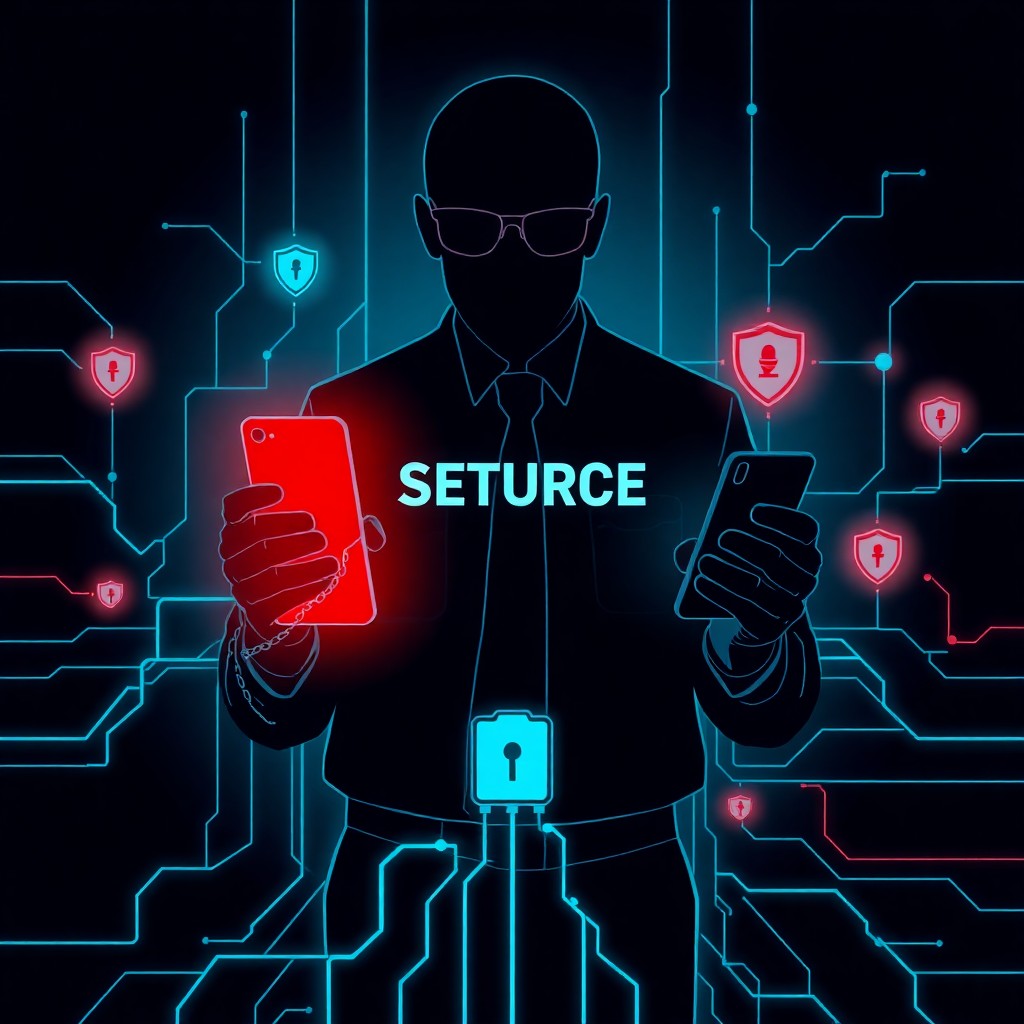
Secret Service agents are reportedly avoiding government-issued devices in favor of personal phones, raising significant operational security (OPSEC) concerns. This practice, while potentially driven by usability or security concerns, creates data exfiltration risks, circumvents monitoring capabilities, and establishes dangerous precedents for security culture within critical government agencies. The revelation highlights fundamental tensions between device control, user experience, and mission-critical security requirements.
Introduction
In a development that should alarm security practitioners across government and enterprise sectors, reports indicate that U.S. Secret Service personnel are bypassing official communication channels by using personal devices instead of government-issued phones. This behavior pattern represents more than a policy violation—it’s a systemic OPSEC failure with implications that extend far beyond a single agency.
When those tasked with protecting the nation’s highest officials opt out of controlled communication systems, it signals either catastrophic usability failures in secure device programs or a fundamental breakdown in security culture. Either scenario demands immediate attention from security teams managing similar environments.
The practice exposes classified communications to unvetted infrastructure, creates data retention nightmares, and potentially compromises operational security during critical protective operations. For security professionals managing device fleets in sensitive environments, this case study offers critical lessons about the real-world consequences of security-usability trade-offs.
Background & Context
Government-issued devices exist within highly controlled environments designed to meet stringent security requirements. These devices typically feature:
- Hardened operating systems with reduced attack surfaces
- Mobile Device Management (MDM) enforcement
- Encrypted communication channels
- Audit logging and monitoring capabilities
- Restricted application ecosystems
- Air-gapped or segmented network access
However, these security controls often come with significant usability penalties. Agents accustomed to consumer-grade smartphone experiences face devices with limited functionality, slower performance, and restrictive policies that impact daily operations.
The Secret Service operates in uniquely challenging environments where communication reliability can be mission-critical. Protective details require instantaneous coordination, intelligence sharing, and situational awareness. Any communication delay or system failure could have catastrophic consequences.
This creates a perfect storm: security requirements demand controlled systems, but operational realities incentivize workarounds. When security controls interfere with mission execution, even well-trained personnel will find alternatives—regardless of policy.
Technical Breakdown
The technical implications of personal device usage in this context are severe:
Data Exfiltration Vectors
Personal devices create uncontrolled data paths:
Controlled Environment          Uncontrolled Environment
─────────────────────          ────────────────────────
Government Device    ─────X───→  Personal Device
    ↓                              ↓
Monitored Network                 Consumer ISP
    ↓                              ↓
Secure Storage                    Cloud Backup
    ↓                              ↓
Audit Trails                      Unknown Retention
Communications that should remain within government infrastructure instead traverse commercial networks, cloud services, and potentially foreign-owned infrastructure.
Authentication Bypass
Government systems implement multi-factor authentication (MFA) and device attestation:
# Expected authentication flow
Device Certificate → VPN Gateway → MFA Challenge → Network Access

# Personal device reality
Consumer App → Public Internet → Unverified Endpoint
Personal devices cannot participate in certificate-based authentication schemes, forcing either bypass mechanisms or complete circumvention of secure channels.
Monitoring Gaps
Enterprise monitoring depends on controlled endpoints:
MDM_Capabilities:
  - Application inventory
  - Network traffic inspection
  - Geolocation tracking
  - Remote wipe capabilities
  - Compliance enforcement

Personal_Device_Reality:
  - Zero visibility
  - No control
  - Unknown applications
  - Unmanaged cloud sync
  - Impossible incident response
Encryption Inconsistencies
Government devices enforce FIPS 140-2 compliant encryption. Personal devices may use:
- Consumer-grade encryption
- Backdoored implementations in certain jurisdictions
- Compromised encryption keys through cloud recovery features
- Unencrypted backup mechanisms
Impact & Risk Assessment
Operational Security Risks
The most immediate danger is compromise of protective operations. If adversaries can access agent communications via personal devices, they gain:
- Advance knowledge of protectee movements
- Insight into security postures and vulnerabilities
- Real-time tactical intelligence during operations
- Historical pattern analysis for future targeting
Data Spillage
Sensitive information residing on personal devices creates:
- Uncontrolled retention beyond approved timelines
- Exposure through device loss or theft
- Inadvertent disclosure via cloud synchronization
- Discovery risks in legal proceedings
- Foreign intelligence collection opportunities
Compliance Violations
This practice likely violates:
- Federal Records Act requirements
- Presidential Records Act obligations
- FISMA compliance mandates
- Agency-specific security policies
- Classification handling requirements
Chain of Custody Issues
For an agency involved in investigations, evidence chain-of-custody becomes problematic when communications occur outside official systems. Defense attorneys could challenge:
- Message authenticity
- Timeline accuracy
- Completeness of production
- Spoliation of evidence claims
Vendor Response
Government device programs typically involve major manufacturers like Samsung, Apple, or specialized secure device vendors operating under GSA contracts. These vendors have invested significantly in government-hardened devices.
The apparent rejection of these solutions suggests either:
- Technical inadequacy: Devices cannot meet operational requirements
- Usability failures: Security controls make devices unusable in field conditions
- Procurement issues: Deployment delays or insufficient device availability
- Training gaps: Personnel lack understanding of device capabilities
Vendors should respond by:
- Conducting field usability studies with actual protective details
- Streamlining security controls that don’t materially reduce risk
- Improving performance to match consumer device expectations
- Enhancing emergency communication reliability
Mitigations & Workarounds
For organizations facing similar challenges:
Immediate Actions
Enforce device usage through technical controls:
# Network ACL enforcement
iptables -A INPUT -m mac --mac-source  -j ACCEPT
iptables -A INPUT -j DROP

# Certificate-based authentication
openssl verify -CAfile agency_ca.pem device_cert.pem
Implement network segmentation requiring device attestation for access to sensitive resources.
Medium-term Solutions
Deploy improved device management:
MDM_Policy:
  Enrollment: Mandatory
  Compliance_Check: Continuous
  Non_Compliance_Action: Network_Isolation
  Allowed_Apps: Whitelist_Only
  Data_Loss_Prevention: Enforced
Long-term Strategy
- Redesign device programs with user experience as a primary requirement
- Implement zero-trust architectures that authenticate users and devices continuously
- Develop bring-your-own-device (BYOD) programs with containerization for less-sensitive functions
- Create security awareness programs that emphasize “why” not just “what”
Detection & Monitoring
Identify shadow IT usage through:
Network Analysis
# Detect unexpected devices
tcpdump -i any -n 'not ether src '

# Monitor for personal device fingerprints
tshark -Y "http.user_agent contains 'iPhone' or http.user_agent contains 'Android'"
Anomaly Detection
Monitor for:
- Authentication attempts from unregistered devices
- VPN connections from consumer IP ranges
- Cloud service access patterns inconsistent with issued devices
- Bluetooth/WiFi probes from unauthorized devices in secure facilities
Behavioral Indicators
- Reduced activity on official devices while operational tempo remains high
- Correlation gaps between physical presence and device location data
- Decreased usage of official communication applications
Best Practices
Organizations managing sensitive device fleets should:
Security-Usability Balance
- Involve end users in device selection and policy development
- Conduct regular usability testing in realistic operational scenarios
- Implement graduated security controls based on actual risk profiles
- Provide clear rationale for security restrictions
Policy Enforcement
- Make compliance technically unavoidable rather than policy-dependent
- Design systems where the secure path is the easiest path
- Implement continuous monitoring rather than periodic audits
- Establish clear consequences for violations with consistent enforcement
Culture Development
- Train personnel on threat models specific to their roles
- Share real-world compromise examples relevant to their missions
- Recognize and reward security-conscious behavior
- Create feedback mechanisms for security improvement suggestions
Technical Architecture
Deploy defense-in-depth assuming device compromise:
Layer 1: Device Hardening
Layer 2: Network Segmentation
Layer 3: Data Encryption
Layer 4: Monitoring & Detection
Layer 5: Incident Response
No single control should represent a complete security dependency.
Key Takeaways
- Security controls that interfere with mission execution will be bypassed regardless of policy
- Personal device usage creates extensive OPSEC vulnerabilities in sensitive environments
- Government device programs must balance security requirements with operational realities
- Technical enforcement is more reliable than policy compliance in high-pressure environments
- Security culture failures at elite agencies should prompt organizational self-assessment
- Usability is a security requirement, not a luxury feature
- Shadow IT in protective services creates unacceptable compromise risks
- Detection and monitoring must account for device-level evasion attempts
References
- NIST SP 800-124 Rev. 2: Guidelines for Managing the Security of Mobile Devices
- NIST SP 800-94: Guide to Intrusion Detection and Prevention Systems
- DHS Mobile Device Security Baseline
- NSA Mobile Device Best Practices
- CISA Mobile Device Security Guidance
- Federal Records Act (44 U.S.C. Chapters 21, 29, 31, 33)
- FISMA Implementation Project
Stay updated at https://cydhaal.com — Your Daily Dose of Cyber Intelligence.
📧 Subscribe to our newsletter at https://cydhaal.com/newsletter/