







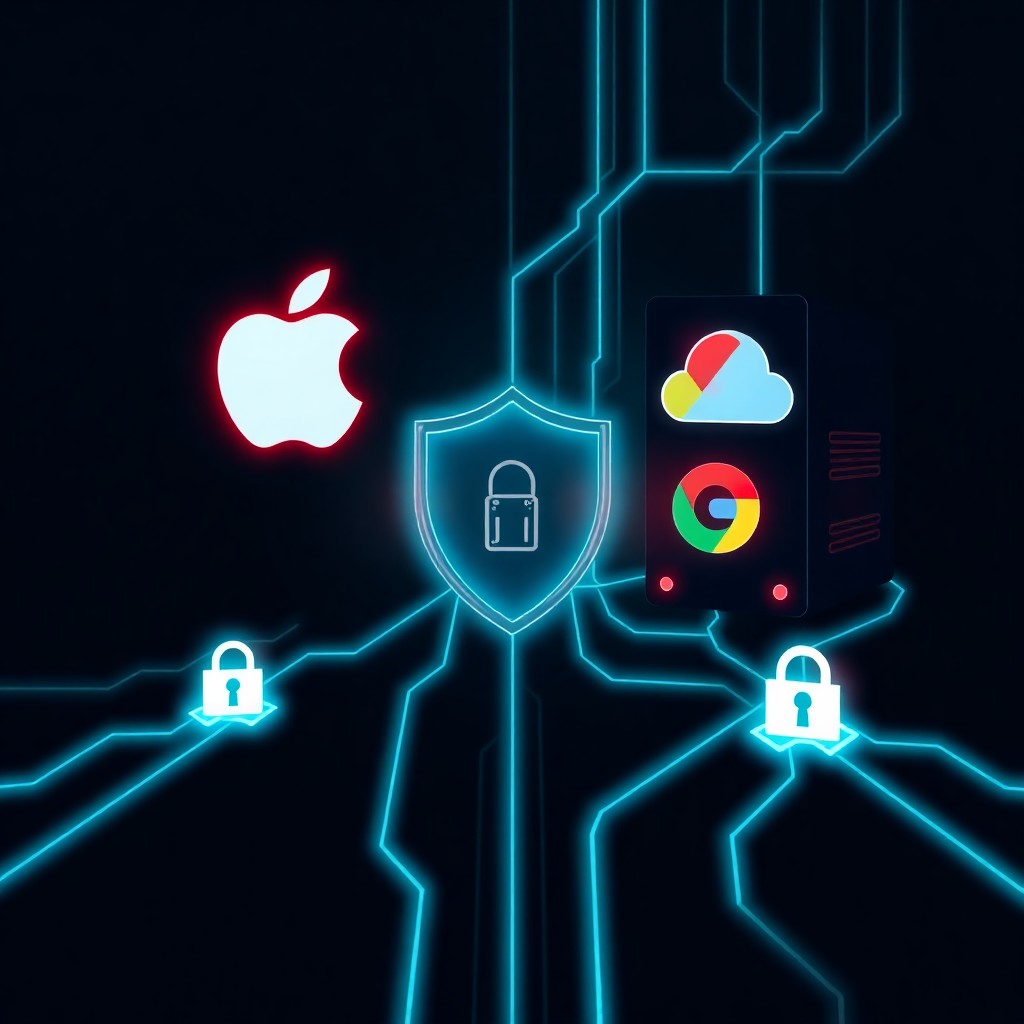
Apple has confirmed that its Apple Intelligence features utilize Google’s Tensor Processing Units (TPUs) for cloud-based AI processing, raising eyebrows about privacy guarantees. Despite outsourcing compute infrastructure to a third-party provider, Apple maintains that user data remains private through its Private Cloud Compute (PCC) architecture. The company claims cryptographic attestation, stateless processing, and end-to-end encryption ensure Google never accesses user queries or personal information, even while hosting the physical servers.
Introduction
In a development that’s sparked intense debate within the cybersecurity community, Apple has acknowledged that some Apple Intelligence workloads run on Google Cloud infrastructure, specifically leveraging Google’s custom AI accelerator chips. For a company whose entire brand identity revolves around privacy—famously refusing FBI requests to unlock iPhones—this partnership represents a significant architectural decision that demands scrutiny.
The revelation came through Apple’s technical documentation for Private Cloud Compute, which detailed that beyond its own custom Apple Silicon servers, the company also utilizes third-party cloud providers for scaling AI inference workloads. While Apple has long positioned itself as the privacy-first alternative to Google’s data-hungry business model, this infrastructure choice forces security professionals to examine whether Apple’s privacy guarantees can survive contact with external cloud providers.
Background & Context
Apple Intelligence, announced at WWDC 2024, represents Apple’s entry into the generative AI race. Unlike competitors who route virtually all AI queries through cloud infrastructure, Apple designed a hybrid approach: simple requests process on-device using Apple Silicon’s Neural Engine, while complex tasks requiring more computational power get sent to cloud servers.
This two-tier architecture necessitated massive computational resources beyond Apple’s existing data center capacity. Rather than delay deployment while building out proprietary infrastructure, Apple opted to leverage third-party cloud providers—including Google Cloud Platform—to meet demand. This decision is particularly notable given the companies’ history: Google pays Apple an estimated $20 billion annually to remain Safari’s default search engine, while simultaneously competing in the smartphone ecosystem.
The technical foundation for Apple’s privacy claims rests on Private Cloud Compute (PCC), a custom-built architecture that Apple describes as “the most advanced security architecture ever deployed for cloud AI compute at scale.” PCC was designed specifically to address the inherent tension between cloud-based AI processing and privacy preservation.
Technical Breakdown
Apple’s Private Cloud Compute architecture implements several layers of cryptographic protection designed to maintain privacy boundaries even when running on third-party infrastructure:
Cryptographic Attestation: Before any user device sends data to a cloud node, it performs remote attestation to verify the server is running genuine Apple PCC software. This attestation uses secure boot chains and cryptographic measurements to ensure the remote environment hasn’t been tampered with or modified.
Device → Attestation Request → Cloud Node
Cloud Node → Signed Boot Measurements → Device
Device validates signatures against Apple's root of trust
Only then: Device → Encrypted User Data → Validated Cloud Node
Stateless Processing Architecture: PCC nodes operate in a stateless manner, meaning they don’t persist any user data after completing a request. When a request arrives, the node decrypts it in memory, processes the AI inference, returns encrypted results, and then purges all data. The servers have no writable persistent storage for user data and use encrypted RAM that gets wiped between requests.
End-to-End Encryption: User queries are encrypted on-device before transmission using keys that only the user’s device and the attested PCC node possess. Google’s infrastructure layer has no access to these encryption keys, meaning that even as the physical host, Google processes only encrypted blobs without visibility into content.
Secure Enclave Integration: The attestation and encryption processes integrate with Apple’s Secure Enclave Processor (SEP) on user devices. The SEP manages the cryptographic keys and performs attestation validation, ensuring that even compromised application processors can’t bypass privacy controls.
Third-Party Auditing: Apple has published the PCC source code for security researchers to audit and offers a bug bounty program specifically for PCC vulnerabilities. This transparency allows independent verification of privacy claims rather than requiring blind trust.
Impact & Risk Assessment
Trust Boundary Analysis: The fundamental question centers on whether technical controls can adequately substitute for physical infrastructure control. While Apple’s cryptographic approach theoretically prevents Google from accessing data, this assumes no vulnerabilities exist in the attestation system, encryption implementation, or stateless processing guarantees.
Attack Surface Expansion: Utilizing third-party infrastructure necessarily expands the attack surface. Potential threat vectors include:
- Sophisticated attacks against the attestation mechanism that could allow malicious nodes to impersonate legitimate PCC servers
- Side-channel attacks leveraging Google’s physical access to observe memory access patterns, power consumption, or electromagnetic emissions
- Supply chain compromises that introduce vulnerabilities before Apple’s attestation system activates
- Legal compulsion scenarios where governments demand Google provide access to encrypted traffic or implement monitoring at the infrastructure level
Regulatory Compliance Concerns: Organizations subject to strict data residency requirements (GDPR, HIPAA, industry-specific regulations) may find the opacity around which cloud provider processes which request problematic for compliance documentation.
Nation-State Threat Implications: Advanced persistent threat actors with potential access to Google’s infrastructure—whether through compromise or legal mechanisms—represent a realistic threat model. While encryption protects data in theory, nation-state actors have repeatedly demonstrated capabilities to exploit implementation vulnerabilities that weren’t apparent to designers.
Vendor Response
Apple has been proactive in addressing privacy concerns through both technical documentation and public statements. The company published extensive technical documentation detailing the PCC architecture, including security guarantees, threat models, and cryptographic protocols.
In official statements, Apple emphasized that no cloud provider—including Google—has any visibility into user data: “Private Cloud Compute cryptographically ensures that iPhone, iPad, and Mac do not communicate with a server unless its software has been publicly logged for inspection. We believe this sets a new standard for privacy in AI.”
Google, for its part, has issued generic statements confirming that its cloud customers control their data encryption and that Google Cloud infrastructure is designed for customer privacy. However, Google has not made specific technical statements about the Apple Intelligence deployment architecture.
Apple has committed to ongoing transparency, including maintaining public logs of PCC software builds and continuing to accept security research submissions through its Security Bounty program, with rewards up to $1 million for PCC-specific vulnerabilities.
Mitigations & Workarounds
For organizations and security-conscious users concerned about the privacy implications:
Disable Cloud Features: Users can restrict Apple Intelligence to on-device processing only by disabling cloud features in Settings:
Settings → Apple Intelligence & Siri →
Disable "Use Apple Intelligence in the Cloud"
This limits functionality but ensures no data leaves the device.
Network-Level Monitoring: Enterprise environments can implement network monitoring to observe when devices connect to Apple Intelligence cloud endpoints and establish baseline traffic patterns for anomaly detection.
MDM Policy Enforcement: Organizations using Mobile Device Management can deploy configuration profiles that restrict cloud-based AI features:
allowCloudAI
Threat Model Assessment: Organizations should evaluate whether their specific threat model includes adversaries with potential access to cloud provider infrastructure and adjust usage policies accordingly.
Detection & Monitoring
Security teams can implement several detection strategies:
Endpoint Monitoring: Deploy EDR solutions that monitor for unexpected network connections or data exfiltration attempts from devices using Apple Intelligence features.
Traffic Analysis: Implement SSL/TLS inspection (where legally and technically feasible) to establish baselines for expected encrypted traffic volumes and patterns.
Attestation Log Monitoring: Apple publishes transparency logs of PCC node software. Security teams can monitor these logs for unexpected changes or anomalies:
# Monitor Apple's transparency log endpoint
curl https://transparency.apple.com/pcc/logs | \
jq '.builds[] | select(.date > "2024-01-01")'
Behavioral Analytics: Establish user behavior baselines and alert on anomalies that might indicate compromised AI features being exploited for data exfiltration.
Best Practices
Privacy-First Configuration: Default to on-device processing unless cloud features are specifically required. Evaluate each AI feature’s necessity against privacy requirements.
Regular Security Reviews: As Apple updates PCC infrastructure and potentially adds cloud providers, periodically review architecture documentation and reassess risk posture.
User Education: Ensure users understand the difference between on-device and cloud-based processing, enabling informed consent about data handling.
Defense in Depth: Don’t rely solely on vendor privacy promises. Implement additional controls like DLP, network segmentation, and data classification to protect sensitive information.
Audit Trail Maintenance: Log and retain records of which devices use cloud AI features, supporting incident response and compliance activities.
Key Takeaways
- Apple Intelligence uses Google TPU infrastructure for some cloud-based AI processing, but implements cryptographic controls intended to prevent Google from accessing user data
- Private Cloud Compute employs attestation, stateless processing, and end-to-end encryption as privacy preservation mechanisms
- The architecture expands attack surface despite technical protections, introducing new threat vectors including side-channel attacks and legal compulsion scenarios
- Users and organizations can disable cloud features entirely to ensure on-device-only processing
- Apple’s transparency efforts, including public source code and bug bounties, enable independent security verification
- Security teams should implement monitoring, establish baselines, and evaluate whether their specific threat models accommodate third-party cloud infrastructure
The Apple-Google infrastructure partnership represents a pragmatic engineering decision that challenges traditional notions of privacy through physical isolation. Whether cryptographic controls provide sufficient privacy guarantees ultimately depends on each organization’s threat model, risk tolerance, and trust in implementation security.
References
- Apple Private Cloud Compute Security Guide: https://security.apple.com/documentation/private-cloud-compute/
- Apple Platform Security Documentation: https://support.apple.com/guide/security/
- Apple Security Bounty Program: https://developer.apple.com/security-bounty/
- PCC Transparency Logs: https://transparency.apple.com/pcc/
- WWDC 2024 Apple Intelligence Session: https://developer.apple.com/wwdc24/
Stay updated at https://cydhaal.com — Your Daily Dose of Cyber Intelligence.
📧 Subscribe to our newsletter at https://cydhaal.com/newsletter/